Questions:
Was working with the model/models for Midwest Olympia challenging (uncofortable, hard to find someone to pose, etc.)?
Is Baiti more of an educational film than a piece of art?
Response:
Quote: "The worst reaction to art is no reaction at all."
Bilal said this in part of an answer to a question from someone in the audience about the seemingly negative reactions he receives from viewers of his art. I've always thought this myself. I've experienced no reactions from artwork I've made, and it's hard to decipher whether your work is unsuccessful, or your audience just doesn't fit when there is not comment whatsoever. I'd rather hear how terrible someone thinks it is than to hear silence.
Three words to describe his practice and artwork:
platform
political
informative
I was surprised to hear at the very end of the lecture that Bilal was forced to leave Iraq because of his artwork about civil rights that didn't align with their government. He was so modest about his courage and perseverance that he made leaving his home country and family for art seem like no big deal.
I don't know the answers to my original questions. My questions didn't seem relevant or important by the end of the lecture.
I found the paintball project to be the most compelling. Not leaving a single room for an entire month is torture enough. Add being continually shot with paintballs to that, and I don't understand how anyone can mentally tolerate that. And it was entirely voluntary...
The more I think about Bilal's work, the more I wonder how satisfied he is with our democratic system. Is America everything he thought it would be? Would he recommend his family live here over Iraq?
Wednesday, September 15, 2010

Idea: Isolation
Synonyms for isolate: Cordon off, seal off, close off, fence off, seperate, set/keep apart, segregate, detach, cut off, shut away, keep in solitude, quarantine, cloister, seclude, sequester, identify, single out, pick out, point out, spot, recognize, distinguish, pinpoint, locate, loner, hermit, lonliness.
Antonyms: Integrate, include, incorporate, mingle, join.
Wikipedia definition of Solitude: Solitude is a state of seclusion or isolation; i.e., lack of contact with people. It may stem from bad relationships, deliberate choice, infectious disease, mental disorders, or circumstances of employment or situation (see castaway).
I found a good article that was the cover story of New York Magazine on November 23rd, 2008. Alone Together by Jennifer Senior argues that urban loneliness caused by so many people living by themselves is largely a myth. It tells of the health effects of extreme isolation and how loneliness is relative. (http://nymag.com/news/features/52450/)
Antonyms: Integrate, include, incorporate, mingle, join.
Wikipedia definition of Solitude: Solitude is a state of seclusion or isolation; i.e., lack of contact with people. It may stem from bad relationships, deliberate choice, infectious disease, mental disorders, or circumstances of employment or situation (see castaway).
Short-term solitude is often valued as a time when one may work, think or rest without being disturbed. It may be desired for the sake of privacy. Many religions promote solitude for meditation.
A distinction can be made between physical and mental seclusion. People may seek physical seclusion to remove distractions and make it easier to concentrate, reflect, or meditate. However, this is not necessarily an end in and of itself. Once a certain capacity to resist distractions is achieved, people become less sensitive to distractions and more capable of maintaining mindfulness and staying inwardly absorbed and concentrated. Such people, unless on a mission of helping others, don't seek any interaction with the external physical world. Their mindfulness is their world, at least ostensibly.
Another distinction has been made between solitude and loneliness. In this sense solitude is positive.
Wiki also explains the different types of solitude:
There are two different common types of human isolation. These are known as protective isolation and source isolation. They are different in that one is voluntary, while the other is not.
Protective isolation is the type of isolation created in tests. This can usually be classified by the fact that one can opt out of the experiment, or the isolation. It can often be prepared for, and is generally not a negative thing. (More often than not, there is a reward for the subject's time as an experiment.)
Source isolation includes no benefits, and cannot be prepared for. Thus, it is usually undesirable, and is not very common.
Emotional isolation is a term used to describe a state of isolation where the individual is emotionally isolated, but may have a well functioning social network.
I found a good article that was the cover story of New York Magazine on November 23rd, 2008. Alone Together by Jennifer Senior argues that urban loneliness caused by so many people living by themselves is largely a myth. It tells of the health effects of extreme isolation and how loneliness is relative. (http://nymag.com/news/features/52450/)
This research is relevant because studying isolation and enjoyable time alone is my concept. Knowing as much as I can about people's interpretation of isolation will help me to better communicate my concept through my images.

Uta Barth
Sunday, September 12, 2010
Artist: Natascha Libbert
Natascha Libbert is a vision of who I want to be in a few years. I am shocked at how similar we are. She deals with ideas of isolation and what humans to do cope with the feeling of separation from the world they live in. She also worked as a flight attendant in order to save money to go back to grad school for photography... which is where she developed and observed the concepts she works with today. Her visual style is also appealing to me. Her compositions aren't over worked, and her color palate and lighting scenarios she typically documents give a welcomed feeling of solitude, mystery, and excitement.
Bio (from her website):
Natascha Libbert (1973) lives and works in The Hague, Holland. After working for several years as an account manager at an ad agency (FHV/BBDO), she decided to become a part-time flight attendant in order to go back to school. She studied photography at the Royal Academy of Arts (KABK) and graduated there in June 2009.
"Photography gives purpose to questions I have. If I would not photograph, I would have to study something like sociology. Or something else to answer questions.
Something which explains how the arrangements and codes we consider normal, came to be that way."


Bio (from her website):
Natascha Libbert (1973) lives and works in The Hague, Holland. After working for several years as an account manager at an ad agency (FHV/BBDO), she decided to become a part-time flight attendant in order to go back to school. She studied photography at the Royal Academy of Arts (KABK) and graduated there in June 2009.
"Photography gives purpose to questions I have. If I would not photograph, I would have to study something like sociology. Or something else to answer questions.
Something which explains how the arrangements and codes we consider normal, came to be that way."
-Natascha Libbert, on what photography means to her (from interview with ILOVETHATPHOTO http://www.ilovethatphoto.net/2010/02/21/interview-natascha-libbert/)
"This is a story about man's attempt to model his surroundings to become that which he envisions as being an ideal world. It is about how a created world has become reality. I perceived this to be especially visible in places such as hotels, airports, lounges, avenues, resorts by the sea. These places seem to present man with a truth which may be difficult to live up to. Details, both subtle and paramount, can be read in the understandable attempt of man to maintain his created decor and himself in it. In the end, what remains is the undercurrent of a man's alienated relationship to the world he created, a feeling of estrangement. This is what I observe as I travel. It is what this story is about."
-Natascha Libbert, statement on her series "Take Me to the Hilton" from her website.


Interview: http://www.ilovethatphoto.net/2010/02/21/interview-natascha-libbert/
Gallery: http://www.vankranendonk.nl/
Website: http://www.nataschalibbert.nl/index.php
Thursday, September 9, 2010
Idea: Metallic Paper
I like the look of metallic photographic paper, but I don't know anything about it. I want to print with it this semester because it makes prints look more dynamic and 3-D. I plan on making three dimensional scenes out of pieces of my photographs so metallic paper should further enhance the look. The subject matter of my photos is somewhat otherworldly and the metallic paper will enhance that as well. How does it work? Kodak's Professional Endura Metallic VC digital paper claims:
Kodak's website: http://www.kodak.com/global/en/professional/products/papers/enduraMetallic/main.jhtml
Another helpful site:
http://www.kodak.com/global/en/professional/products/papers/enduraMetallic/main.jhtml

ENDURA Metallic VC Paper uses a proprietary combination of film laminate layers to produce three-dimensional, outstanding, lasting images on an ultra-bright background. Its professional emulsion set provides extreme sharpness, brightness, and color saturation with an intense black density that increases visual appeal. |
Kodak's website: http://www.kodak.com/global/en/professional/products/papers/enduraMetallic/main.jhtml
Another helpful site:
http://www.kodak.com/global/en/professional/products/papers/enduraMetallic/main.jhtml

This is an image printed on metallic paper I found for sale on Etsy
http://www.etsy.com/listing/22022190/skycab-no-1-6x9-metallic-print-matted-to
Tuesday, September 7, 2010
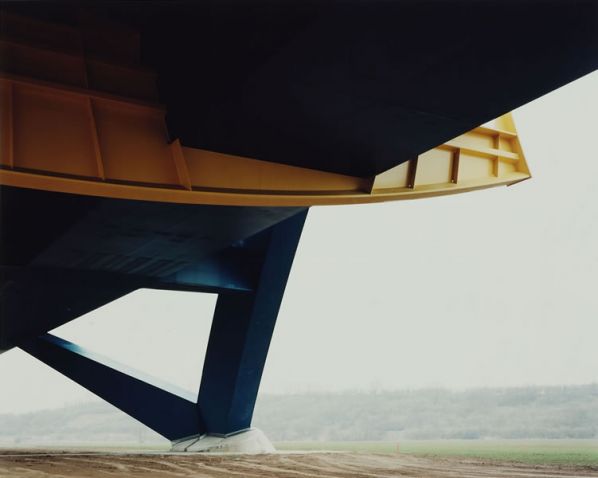
Artist: Hans-Christian Schink
Hans-Christian Schink's concepts of isolation, the outsider looking in becoming aware of their own existence through the feeling of alienation, and creating order within a vague point of view are many of the things I have made art about in the past, and want to continue. It is helpful for me to read how his art is described, and what others see in the photographs in order to better narrow my focus on broader ideas I've had about these concepts. When I first saw Schink's photos without having researched the concept, I liked that they immediately communicated that feeling of isolation and outsider's perspective visually. I need improve on how to successfully communicate my ideas visually so my viewers can catch on to my concept in much the same way.
Biography from Rothamel Gallery:
"Since the beginning of the 1990s Hans Christian Schink has traced, in different photography series, the appearance of this desire for order. In these he reveals, on the one hand the fascination of the educated artist with architectural details as "finished" compositional models, and on the other hand they reveal a critical dimension in the proportionally tense imbalance between architecture and nature. His pictures however always retain a distance - he captures fictitiously, in a photographic act, the position of the indifferent observer who reproduces simply the apparent, what "is" (what he sees), yet on the other hand (as an inheritance from the German early romantics), an attitude signalising lost proximity, a melancholy of loss.
When Hans-Christian Schink arrives in 2002 in Los Angeles (with a scholarship from the Villa Aurora) he will be interested primarily in the periphery of the urban, which brings to light the moving interplay of different systems of order: on the one hand the objects of order and general economic set-up determined by man's will to create, and on the other hand the "rightness" of nature with its own patterns of growth and passing, sedimentation and washing away. Twenty years before, between 1978 and 1983, the American photographer Robert Adams had explored the social and ecological distortions in the surrounding areas of the Megapolis, in his Californian pictures, so that one does not certainly, from some similarity of motives, go from a secret homage to the master of the precise observation of the inconspicuous. But where Adams mixes in the invisible middle of the world, to which he loans a photographic face, Hans-Christian Schink remains in the position of the outsider, on a Baudelairian stroll, that photographs and interprets only from one's existence in the mode of distance and alienation. Therefore his landscapes have the effect of still-lives, which obviously consume, exhaust, captivate and are brought to rest."
Quotes:
"Schink is always interested in letting the physical structure of his subjects take the narrative lead, keeping the possible fictions as vague as his passersby point of view."
"In the way his work expresses a kind of random, all-encompassing visual wandering, writer Kai Uwe Schiertz has compared Schink to the Baudelairian stroller, effortlessly noting anything and everything, always outside the contemplated world. It's a kind of unprecious humanising, or miniaturising of the impossible largeness of the other, one could say."
-Lupe Nunez-Fernandez, The Saachai Gallery, http://www.saatchi-gallery.co.uk/blogon/art_news/hans_christian_schink_at_arnes_&_roepke_madrid/3089


Interview:
http://www.realphotographyaward.com/winner_2007_2008/finalists_interviews
Artist website:
http://www.hc-schink.de/fotos/photographs_e.html
Ace Gallery:
http://www.acegallery.net/artistmenu.php?Artist=11
Rothamel Gallery:
http://www.rothamel.de/en/Hans-Christian-Schink/index.html
Biography from Rothamel Gallery:
"Since the beginning of the 1990s Hans Christian Schink has traced, in different photography series, the appearance of this desire for order. In these he reveals, on the one hand the fascination of the educated artist with architectural details as "finished" compositional models, and on the other hand they reveal a critical dimension in the proportionally tense imbalance between architecture and nature. His pictures however always retain a distance - he captures fictitiously, in a photographic act, the position of the indifferent observer who reproduces simply the apparent, what "is" (what he sees), yet on the other hand (as an inheritance from the German early romantics), an attitude signalising lost proximity, a melancholy of loss.
When Hans-Christian Schink arrives in 2002 in Los Angeles (with a scholarship from the Villa Aurora) he will be interested primarily in the periphery of the urban, which brings to light the moving interplay of different systems of order: on the one hand the objects of order and general economic set-up determined by man's will to create, and on the other hand the "rightness" of nature with its own patterns of growth and passing, sedimentation and washing away. Twenty years before, between 1978 and 1983, the American photographer Robert Adams had explored the social and ecological distortions in the surrounding areas of the Megapolis, in his Californian pictures, so that one does not certainly, from some similarity of motives, go from a secret homage to the master of the precise observation of the inconspicuous. But where Adams mixes in the invisible middle of the world, to which he loans a photographic face, Hans-Christian Schink remains in the position of the outsider, on a Baudelairian stroll, that photographs and interprets only from one's existence in the mode of distance and alienation. Therefore his landscapes have the effect of still-lives, which obviously consume, exhaust, captivate and are brought to rest."
Quotes:
"Schink is always interested in letting the physical structure of his subjects take the narrative lead, keeping the possible fictions as vague as his passersby point of view."
"In the way his work expresses a kind of random, all-encompassing visual wandering, writer Kai Uwe Schiertz has compared Schink to the Baudelairian stroller, effortlessly noting anything and everything, always outside the contemplated world. It's a kind of unprecious humanising, or miniaturising of the impossible largeness of the other, one could say."
-Lupe Nunez-Fernandez, The Saachai Gallery, http://www.saatchi-gallery.co.uk/blogon/art_news/hans_christian_schink_at_arnes_&_roepke_madrid/3089


Interview:
http://www.realphotographyaward.com/winner_2007_2008/finalists_interviews
Artist website:
http://www.hc-schink.de/fotos/photographs_e.html
Ace Gallery:
http://www.acegallery.net/artistmenu.php?Artist=11
Rothamel Gallery:
http://www.rothamel.de/en/Hans-Christian-Schink/index.html
Wednesday, September 1, 2010
Idea: Flight Attendants
I like the quote Paul mentioned on the first day of class about when you know if you're a "photographer" or not. He said you are a photographer the day you decide you don't want to be one anymore.
I decided this summer I want to be a flight attendant. So I must be a photographer.
A flight attendant's ( historically stewards/stewardesses or air hosts/hostesses) main focus is the safety of the passengers on board the plane. Customer service is also an integral part of the job. It's appealing to me to have a job where I have to potential to take control in emergency situations. Wikipedia actually has a good list of notable flight attendants and specific situations where they have helped save people (http://en.wikipedia.org/wiki/Flight_attendant). Then there's the completely selfish side of the job, where you get to travel to exotic places and fly for close to nothing on days off and only work a small amount of hours a week all while getting paid well.
Quotes:
"Our lives are shaped by space at the same time that we, in turn, shape space"
-Drew Whitelegg from his book Working the Skies: The Fast-Paced, Disorienting World of the Flight Attendant (only slightly dramatic)
"The small square suitcases we pulled through airports were packed for overnights in Cairo or Paris or San Francisco or Las Vegas. Rather than promotions or upward mobility, we had the lure of the whole wide world."
-Ann Hood from the article "Behind the Scences With a Flight Attendant" from travelandleisure.com (http://www.travelandleisure.com/articles/behind-the-scenes-with-a-flight-attendant/1)
The book, Working the Skies: The Fast-Paced, Disorienting World of the Flight Attendant by Drew Whitelegg sounds like a great source for learning the truth about the lifestyle of a flight attendant.
Whitelegg interviews over 60 flight attendants to gather his in-depth accounts what the life of a flight attendant is really like. He addresses everything from the potential danger, to the jetlag, to the rude passengers. The author manages to make this an amusing but informative read. He does tend to over dramatize at points, which is the only real downfall of the book.
(http://www.amazon.com/Working-Skies-Fast-Paced-Disorienting-Attendant/dp/0814794084/ref=sr_1_8?s=books&ie=UTF8&qid=1281545706&sr=1-8)
The idea of being a flight attendant is something I can't seem to stop thinking about, but it doesn't necessarily mean I want to make photographs dealing directly with airline imagery. Visually, the exotic travel destinations and even the uniforms, make for interesting subjects. Conceptually I'm more interested in the idea of an independent woman that never stays in one place, and the idea of looking put together while feeling truly the opposite (like when dealing with problem passengers). In the past I've done a lot of work about being alone, as well as investigating female identities, both of which could tie in conceptually.

This photo is from a series called Flight Attendants by Brian Finke. I'm sure I will do an artist entry on this in the near future. It can be seen here: http://www.egodesign.ca/en/article.php?article_id=335&page=1
I decided this summer I want to be a flight attendant. So I must be a photographer.
A flight attendant's ( historically stewards/stewardesses or air hosts/hostesses) main focus is the safety of the passengers on board the plane. Customer service is also an integral part of the job. It's appealing to me to have a job where I have to potential to take control in emergency situations. Wikipedia actually has a good list of notable flight attendants and specific situations where they have helped save people (http://en.wikipedia.org/wiki/Flight_attendant). Then there's the completely selfish side of the job, where you get to travel to exotic places and fly for close to nothing on days off and only work a small amount of hours a week all while getting paid well.
Quotes:
"Our lives are shaped by space at the same time that we, in turn, shape space"
-Drew Whitelegg from his book Working the Skies: The Fast-Paced, Disorienting World of the Flight Attendant (only slightly dramatic)
"The small square suitcases we pulled through airports were packed for overnights in Cairo or Paris or San Francisco or Las Vegas. Rather than promotions or upward mobility, we had the lure of the whole wide world."
-Ann Hood from the article "Behind the Scences With a Flight Attendant" from travelandleisure.com (http://www.travelandleisure.com/articles/behind-the-scenes-with-a-flight-attendant/1)
The book, Working the Skies: The Fast-Paced, Disorienting World of the Flight Attendant by Drew Whitelegg sounds like a great source for learning the truth about the lifestyle of a flight attendant.
Whitelegg interviews over 60 flight attendants to gather his in-depth accounts what the life of a flight attendant is really like. He addresses everything from the potential danger, to the jetlag, to the rude passengers. The author manages to make this an amusing but informative read. He does tend to over dramatize at points, which is the only real downfall of the book.
(http://www.amazon.com/Working-Skies-Fast-Paced-Disorienting-Attendant/dp/0814794084/ref=sr_1_8?s=books&ie=UTF8&qid=1281545706&sr=1-8)
The idea of being a flight attendant is something I can't seem to stop thinking about, but it doesn't necessarily mean I want to make photographs dealing directly with airline imagery. Visually, the exotic travel destinations and even the uniforms, make for interesting subjects. Conceptually I'm more interested in the idea of an independent woman that never stays in one place, and the idea of looking put together while feeling truly the opposite (like when dealing with problem passengers). In the past I've done a lot of work about being alone, as well as investigating female identities, both of which could tie in conceptually.

This photo is from a series called Flight Attendants by Brian Finke. I'm sure I will do an artist entry on this in the near future. It can be seen here: http://www.egodesign.ca/en/article.php?article_id=335&page=1
Subscribe to:
Posts (Atom)